Showing posts with label the. Show all posts

Wednesday, March 18, 2015

Construction of Single Phase Induction Motor Excerpt from the book THE BOY MECHANIC

The following notes on a small single-phase induction motor, without auxiliary phase, which the writer has made, may be of interest to some of our readers, says the Model Engineer.
The problem to be solved was the construction of a motor large enough to drive a sewing machine or very light lathe, to be supplied with 110-volt alternating current from a lighting circuit, and to consume, if possible, no more current than a 16-cp. lamp.
In designing, it had to be borne in mind that, with the exception of insulated wire, no special materials could be obtained.

The principle of an induction motor is quite different from that of the commutator motor. The winding of the armature, or "rotor," has no connection with the outside circuit, but the current is induced in it by the action of the alternating current supplied to the winding of the field-magnet, or "stator." Neither commutator nor slip rings are required, and all sparking is avoided. Unfortunately, this little machine is not self-starting, but a slight pull on the belt just as the current is turned on is all that is needed, and the motor rapidly gathers speed provided no load is put on until it is in step with the alternations of the supply. It then runs at constant speed whether given much or little current, but stops if overloaded for more than a few seconds.

The stator has four poles and is built up of pieces of sheet iron used for stove pipes, which runs about 35 sheets to the inch. All the pieces are alike and cut on the lines with the dimensions as shown in Fig. 1, with the dotted line, C, to be filed out after they are placed together. Each layer of four is placed with the pointed ends of the pieces alternately to the right and left so as to break joints as shown in Fig. 2. The laminations were carefully built up on a board into which heavy wires had been driven to keep them in place until all were in position and the whole could be clamped down. In the middle of the pieces 1/4-in. holes, B, were then drilled and 1/4-in. bolts put in and tightened up, large holes being cut through the wood to enable this to be done. The armature tunnel was then carefully filed out and all taken apart again so that the rough edges could be scraped off and the laminations given a thin coat of shellac varnish on one side. After assembling a second time, the bolts were coated with shellac and put into place for good. Holes 5-32 in. in diameter were drilled in the corners, A, and filled with rivets, also varnished before they were put in. When put together they should make a piece 2 in. thick.

This peculiar construction was adopted because proper stampings were not available, and as every bit of sheet iron had to be cut with a small pair of tinners snips, it was important to have a very simple outline for the pieces. They are not particularly accurate as it is, and when some of them got out of their proper order while being varnished, an awkward job occurred in the magnet which was never entirely corrected. No doubt some energy is lost through the large number of joints, all representing breaks in the magnetic circuit, but as the laminations are tightly held together and the circuit is about as compact as it could possibly be, probably the loss is not as great as it would appear at first sight.

The rotor is made of laminations cut from sheet iron, as shown in Fig. 3, which were varnished lightly on one side and clamped on the shaft between two nuts in the usual way. A very slight cut was taken in the lathe afterwards to true the circumference. The shaft was turned from 1/2-in. wrought iron, no steel being obtainable, and is shown with dimensions in Fig. 4. The bearings were cast of babbitt metal, as shown in Fig. 5, in a wooden mold and bored to size with a twist drill in the lathe. They are fitted with ordinary wick lubricators. Figures 6 and 7 are sections showing the general arrangement of the machine.

The stator is wound full with No. 22 double cotton-covered copper wire, about 2-1/2 lb. being used, and the connections are such as to produce alternate poles—that is, the end of the first coil is joined to the end of the second the beginning of the second to the beginning of the third, and the end of the third to the end of the fourth, while the beginnings of the first and fourth coils connect to the supply.

The rotor is wound with No. 24 double cotton-covered copper wire, each limb being filled with about 200 turns, and all wound in the same direction. The four commencing ends are connected together on one side of the rotor and the four finishing ends are soldered together on the other. All winding spaces are carefully covered with two layers of cambric soaked in shellac, and as each layer of wire was wound, it was well saturated with varnish before the next was put on.

This type of motor has drawbacks, as before stated, but if regular stampings are used for the laminations, it would be very simple to build, having no commutator or brushes, and would not easily get out of order. No starting resistance is needed, and as the motor runs at constant speed, depending upon the number of alternations of the supply, a regulating resistance is not needed.


Excerpt from the book:
THE BOY MECHANIC
VOLUME I
700 THINGS FOR BOYS TO DO
WITH 800 ILLUSTRATIONS
1913, BY H. H. WINDSOR CHICAGO
POPULAR MECHANICS CO. PUBLISHERS

Hermes the Greek God Greek Mythology

Hermes was the swift-footed messenger, and trusted ambassador of all the gods, and conductor of shades to Hades. He presided over the rearing and education of the young, and encouraged gymnastic exercises and athletic pursuits, for which reason, all gymnasiums and wrestling schools throughout Greece were adorned with his statues. He is said to have invented the alphabet, and to have taught the art of interpreting foreign languages, and his versatility, sagacity, and cunning were so extraordinary, that Zeus invariably chose him as his attendant, when, disguised as a mortal, he journeyed on earth.

Hermes was worshipped as god of eloquence, most probably from the fact that, in his office as ambassador, this faculty was indispensable to the successful issue of the negotiations with which he was intrusted. He was regarded as the god who granted increase and prosperity to flocks and herds, and, on this account, was worshipped with special veneration by herdsmen.

In ancient times, trade was conducted chiefly by means of the exchange of cattle. Hermes, therefore, as god of herdsmen, came to be regarded as the protector of merchants, and, as ready wit and adroitness are valuable qualities both in buying and selling, he was also looked upon as the patron of artifice and cunning. Indeed, so deeply was this notion rooted in the minds of the Greek people, that he was popularly believed to be also god of thieves, and of all persons who live by their wits.
A Herma
As the patron of commerce, Hermes was naturally supposed to be the promoter of intercourse among nations; hence, he is essentially the god of travellers, over whose safety he presided, and he severely punished those who refused assistance to the lost or weary wayfarer. He was also guardian of streets and roads, and his statues, called Hermæ (which were pillars of stone surmounted by a head of Hermes), were placed at cross-roads, and frequently in streets and public squares.

Being the god of all undertakings in which gain was a feature, he was worshipped as the giver of wealth and good luck, and any unexpected stroke of fortune was attributed to his influence. He also presided over the game of dice, in which he is said to have been instructed by Apollo.

Hermes was the son of Zeus and Maia, the eldest and most beautiful of the seven Pleiades (daughters of Atlas), and was born in a cave of Mount Cyllene in Arcadia. As a mere babe, he exhibited an extraordinary faculty for cunning and dissimulation; in fact, he was a thief from his cradle, for, not many hours after his birth, we find him creeping stealthily out of the cave in which he was born, in order to steal some oxen belonging to his brother Apollo, who was at this time feeding the flocks of Admetus. But he had not proceeded very far on his expedition before he found a tortoise, which he killed, and, stretching seven strings across the empty shell, invented a lyre, upon which he at once began to play with exquisite skill. When he had sufficiently amused himself with the instrument, he placed it in his cradle, and then resumed his journey to Pieria, where the cattle of Admetus were grazing. Arriving at sunset at his destination, he succeeded in separating fifty oxen from his brothers herd, which he now drove before him, taking the precaution to cover his feet with sandals made of twigs of myrtle, in order to escape detection. But the little rogue was not unobserved, for the theft had been witnessed by an old shepherd named Battus, who was tending the flocks of Neleus, king of Pylos (father of Nestor). Hermes, frightened at being discovered, bribed him with the finest cow in the herd not to betray him, and Battus promised to keep the secret. But Hermes, astute as he was dishonest, determined to test the shepherds integrity. Feigning to go away, he assumed the form of Admetus, and then returning to the spot offered the old man two of his best oxen if he would disclose the author of the theft. The ruse succeeded, for the avaricious shepherd, unable to resist the tempting bait, gave the desired information, upon which Hermes, exerting his divine power, changed him into a lump of touchstone, as a punishment for his treachery and avarice. Hermes now killed two of the oxen, which he sacrificed to himself and the other gods, concealing the remainder in the cave. He then carefully extinguished the fire, and, after throwing his twig shoes into the river Alpheus, returned to Cyllene.
Apollo, by means of his all-seeing power, soon discovered who it was that had robbed him, and hastening to Cyllene, demanded restitution of his property. On his complaining to Maia of her sons conduct, she pointed to the innocent babe then lying, apparently fast asleep, in his cradle, whereupon, Apollo angrily aroused the pretended sleeper, and charged him with the theft; but the child stoutly denied all knowledge of it, and so cleverly did he play his part, that he even inquired in the most naive manner what sort of animals cows were. Apollo threatened to throw him into Tartarus if he would not confess the truth, but all to no purpose. At last, he seized the babe in his arms, and brought him into the presence of his august father, who was seated in the council chamber of the gods. Zeus listened to the charge made by Apollo, and then sternly desired Hermes to say where he had hidden the cattle. The child, who was still in swaddling-clothes, looked up bravely into his fathers face and said, "Now, do I look capable of driving away a herd of cattle; I, who was only born yesterday, and whose feet are much too soft and tender to tread in rough places? Until this moment, I lay in sweet sleep on my mothers bosom, and have never even crossed the threshold of our dwelling. You know well that I am not guilty; but, if you wish, I will affirm it by the most solemn oaths." As the child stood before him, looking the picture of innocence, Zeus could not refrain from smiling at his cleverness and cunning, but, being perfectly aware of his guilt, he commanded him to conduct Apollo to the cave where he had concealed the herd, and Hermes, seeing that further subterfuge was useless, unhesitatingly obeyed. But when the divine shepherd was about to drive his cattle back into Pieria, Hermes, as though by chance, touched the chords of his [121]lyre. Hitherto Apollo had heard nothing but the music of his own three-stringed lyre and the syrinx, or Pans pipe, and, as he listened entranced to the delightful strains of this new instrument, his longing to possess it became so great, that he gladly offered the oxen in exchange, promising at the same time, to give Hermes full dominion over flocks and herds, as well as over horses, and all the wild animals of the woods and forests. The offer was accepted, and, a reconciliation being thus effected between the brothers, Hermes became henceforth god of herdsmen, whilst Apollo devoted himself enthusiastically to the art of music.
They now proceeded together to Olympus, where Apollo introduced Hermes as his chosen friend and companion, and, having made him swear by the Styx, that he would never steal his lyre or bow, nor invade his sanctuary at Delphi, he presented him with the Caduceus, or golden wand. This wand was surmounted by wings, and on presenting it to Hermes, Apollo informed him that it possessed the faculty of uniting in love, all beings divided by hate. Wishing to prove the truth of this assertion, Hermes threw it down between two snakes which were fighting, whereupon the angry combatants clasped each other in a loving embrace, and curling round the staff, remained ever after permanently attached to it. The wand itself typified power; the serpents, wisdom; and the wings, despatch—all qualities characteristic of a trustworthy ambassador.

The young god was now presented by his father with a winged silver cap (Petasus), and also with silver wings for his feet (Talaria), and was forthwith appointed herald of the gods, and conductor of shades to Hades, which office had hitherto been filled by Aïdes.

As messenger of the gods, we find him employed on all occasions requiring special skill, tact, or despatch. Thus he conducts Hera, Athene, and Aphrodite to Paris, leads Priam to Achilles to demand the body of Hector, [122]binds Prometheus to Mount Caucasus, secures Ixion to the eternally revolving wheel, destroys Argus, the hundred-eyed guardian of Io, &c. &c.

As conductor of shades, Hermes was always invoked by the dying to grant them a safe and speedy passage across the Styx. He also possessed the power of bringing back departed spirits to the upper world, and was, therefore, the mediator between the living and the dead.

The poets relate many amusing stories of the youthful tricks played by this mischief-loving god upon the other immortals. For instance, he had the audacity to extract the Medusas head from the shield of Athene, which he playfully attached to the back of Hephæstus; he also stole the girdle of Aphrodite; deprived Artemis of her arrows, and Ares of his spear, but these acts were always performed with such graceful dexterity, combined with such perfect good humour, that even the gods and goddesses he thus provoked, were fain to pardon him, and he became a universal favourite with them all.

It is said that Hermes was one day flying over Athens, when, looking down into the city, he beheld a number of maidens returning in solemn procession from the temple of Pallas-Athene. Foremost among them was Herse, the beautiful daughter of king Cecrops, and Hermes was so struck with her exceeding loveliness that he determined to seek an interview with her. He accordingly presented himself at the royal palace, and begged her sister Agraulos to favour his suit; but, being of an avaricious turn of mind, she refused to do so without the payment of an enormous sum of money. It did not take the messenger of the gods long to obtain the means of fulfilling this condition, and he soon returned with a well-filled purse. But meanwhile Athene, to punish the cupidity of Agraulos, had caused the demon of envy to take possession of her, and the consequence was, that, being unable to contemplate the happiness of her sister, she sat down before the door, and resolutely refused to allow Hermes to enter. He tried every persuasion and blandishment in his power, but she still remained obstinate. At last, his patience [123]being exhausted, he changed her into a mass of black stone, and, the obstacle to his wishes being removed, he succeeded in persuading Herse to become his wife.
Hermes
In his statues, Hermes is represented as a beardless youth, with broad chest and graceful but muscular limbs; the face is handsome and intelligent, and a genial smile of kindly benevolence plays round the delicately chiselled lips.

As messenger of the gods he wears the Petasus and Talaria, and bears in his hand the Caduceus or heralds staff.

As god of eloquence, he is often represented with chains of gold hanging from his lips, whilst, as the patron of merchants, he bears a purse in his hand.

The wonderful excavations in Olympia, to which allusion has already been made, have brought to light an exquisite marble group of Hermes and the infant Bacchus, by Praxiteles. In this great work of art, Hermes is represented as a young and handsome man, who is looking down kindly and affectionately at the child resting on his arm, but unfortunately nothing remains of the infant save the right hand, which is laid lovingly on the shoulder of his protector.

The sacrifices to Hermes consisted of incense, honey, cakes, pigs, and especially lambs and young goats. As god of eloquence, the tongues of animals were sacrificed to him.


Text:
Myths and Legends of Ancient Greece and Rome
Author: E.M. Berens
Published: 1880

The Project Gutenberg EBook
Produced by Alicia Williams, Keith Edkins and the Online
Distributed Proofreading Team at http://www.pgdp.net

Tuesday, March 17, 2015

What the appendix is good for


[Article Image]


It was a Saturday morning in 1991 when 12-year old Heather Smith woke up feeling nauseous. Spring break was just beginning, and her parents were planning to take her skiing the next day in Flagstaff, Ariz. — two hours from their home in Tempe.
A stomachache was not how Smith wanted to start vacation. “I was hoping I would get better,” she says, “So I could go ski.”
As the day progressed, things worsened. A sharp pain developed in her lower right side. She couldn’t swallow the soup her sister warmed up for her at lunchtime. By the time she saw a doctor later that afternoon, she was hunched over in pain.
When she learned that her appendix was infected, she didn’t have much time to be afraid. She was rushed into surgery. The next morning, her appendix was gone.
“It was a little scary because it happened so quickly,” says Smith, now an evolutionary biologist at the Arizona College of Osteopathic Medicine at Midwestern University in Glendale, Ariz. But she has never missed her long-lost organ. In fact, the emergency left her with a lifelong fascination for a body part she no longer has.
“I have always been interested in the appendix and trying to figure out why we have one,” Smith says. “There’s been this idea for so long that it didn’t do anything.”
Appendices have long been considered “vestigial structures.” That means we don’t actually need them. The brain, heart, skin and most other organs are essential for survival. But you can live a long life without an appendix. The same goes for tonsils, wisdom teeth, body hair and other vestigial structures.
At best, according to traditional thinking, vestigial structures just take up space. At worst, they can get infected and cause all sorts of trouble. So why do we have these unnecessary body parts in the first place?
Growing evidence suggests that we have them because they aren’t actually unnecessary at all. Their function probably depends on where you live (and perhaps when you lived). In some parts of the world, people still need vestigial body parts. Studying where and when these features are or were useful is helping scientists make new advances in modern medicine. The work is also providing insight into the history of humankind — telling scientists things about our ancestors that we didn’t know before.
“It may be the case with a lot of unnecessary body parts that they may have had a function in the past but we don’t necessarily need that function anymore,” says Smith, who ended up studying the appendix sort of by accident. “That can give us insights.”
The hidden point
The appendix is a small organ that looks like a little worm (lower  left of image). It doesnt lead anywhere, but may serve as a haven for  good bacteria.
The appendix is a small organ that looks like a little worm (lower left of image). It doesnt lead anywhere, but may serve as a haven for good bacteria.
3drenderings/iStockphoto
Consider your body, and you’ll notice a hodgepodge of random features that might seem silly when you stop to think about them. What’s the point of fingernails, for example? Why is there hair on your toes? And what’s the deal with muscles in your ears? Do we really need muscles in our ears?
Throughout history, scientists, too, have wondered about structures that don’t seem to do anything useful. The appendix is a popular example. This little, worm-like pouch is about four inches long and less than half an inch wide.
The organ grows near where the long intestine meets the short intestine. The intestines are essential for digestion, but the appendix appears to just sit there.
“It’s a dead-end sack,” says William Parker, an immunologist at Duke University in Durham, N.C. “It doesn’t go anywhere.”
Parker didn’t start out intending to study the appendix. His specialty is the immune system — a collection of organs, cells and molecules that our bodies use to stay healthy. But his research led him to the appendix anyway.
Parker knew that the human body is full of tiny organisms called bacteria, which can overwhelm the immune system, cause infections and make a person sick. He also knew that some bacteria are good for human health. Among other benefits, these “good” bacteria help people digest food and fight off “bad” bacteria that cause disease.
The immune system doesn’t just benefit from good bacteria, though. In the 1990s, Parker and colleagues began to figure out that the immune system also helps good bacteria flourish. These bacteria appear in thin layers called biofilms, which grow on the side of the gut near and inside the appendix. These biofilms, the researchers learned, provide a barrier that keep out bad bacteria.
“Once we figured that out, it should have been obvious to us what the appendix did,” says Parker, whose team also found that the appendix has a particularly robust biofilm. “It’s in the perfect spot to harbor bacteria — out of the flow and with a thin, narrow opening. And there’s a large amount of immune tissue associated with it.”
After stumbling on a possible link between the immune system and the appendix, though, the scientists still had some clues to compile before being sure of the organ’s purpose.
Hangout for good bacteria In 2007, Parker’s team put together all the evidence they had gathered and came up with a conclusion: The appendix serves as a “safe house,” Parker says, a storage bin for good bacteria. If bad bacteria attack, good bacteria emerge from the appendix and come to the rescue.
Having a safe space for good bacteria should be especially useful in parts of the world that are poor and undeveloped — places where people are starving, medicine is hard to come by, clean water is scarce and diarrhea can kill. In those places, Parker says, the appendix probably helps keep people alive, especially young children.
In fact, people in the developing world rarely get infected appendixes, like Smith’s. Most cases of appendicitis, in fact, occur in the United States and other developed countries, where water is purified, hospitals are sterilized and medical care is easier to get.
Those trends suggest that the appendix evolved in our ancestors to maintain health in a bacteria-filled world. Today, places such as the United States might be too sterile for the appendix. When the organ has nothing do, the immune system can turn on itself, sending people to the emergency room, Parker says. Other problems, such as allergies and immune diseases, might have similar roots.
Even in ultra-clean societies, then, the appendix and other vestigial organs might be unrecognized heroes.
“Just because body parts don’t seem to have any usefulness here doesn’t mean you wouldn’t need them if you were suddenly thrown in the middle of the woods somewhere and had to drink from whatever mud hole you could find nearby and you had to run away from predators,” Parker says. “Problems we are having today with allergies and autoimmune diseases are a result of the body not really fitting in with our culture.”
Figuring out the true purpose of the appendix and other overlooked organs, Parker adds, is an important step toward solving medical mysteries.
“We want to understand how the body functions so we can work towards getting it to function normally,” he says.
To do that, it can help to take an historical view. By considering what was normal a long time ago and comparing the old normal to the new normal, researchers can see how evolution has shaped our bodies over hundreds of thousands of years. That process of change over time is called evolution.
“The best way to figure out how the body was designed to work,” Parker says, “is to look at how it was meant to work over hundreds of millions of years of evolution.”
Wise beyond our years The appendix isn’t the only example of a body part with hidden powers. Wisdom teeth are another. This final set of molars usually grows in at around age 20. Today, most people get their wisdom teeth removed before the bulky molars can squeeze other teeth out of place or get infected.
Millions of years ago, though, human faces weren’t as flat as they are today and mouths had more room for wisdom teeth. After 20 years of life without dental care, our ancestors would have benefited from a fresh set of strong teeth that could chew and grind raw food.
Our ancestors may have found wisdom teeth more useful than we do.
Lakhesis/iStockphoto
As for other structures long thought to be pointless, a recent study found that the spleen stores a whole lot of immune cells. Among other roles, those cells help to repair hearts that are damaged. Tonsils, which are also removed routinely in many developed countries, probably help boost the immune system, as well, Parker says.
As they continue to find purposes for seemingly purposeless body parts, scientists are connecting our present with the past. They are also connecting the human animal with other animals on Earth.
Last year, Smith teamed up with Parker and other colleagues to look at a whole bunch of mammal species, some that lived tens of millions of years ago. The researchers found that the appendix has existed in a wide range of animals, from rodents to primates to Australian marsupials. The study also revealed that the appendix evolved more than once throughout history. Both findings suggest that the appendix has had an important purpose throughout time.
By looking closely at our body’s “pointless” parts, we can begin to imagine what our bodies used to be able to do. Recognizing the body’s lingering power could also open up a whole new future of possibilities.
“Our evolution gives our bodies a lot of resilience and strength we really don’t need very much in our society,” says Parker. “I sit around in my office and have all the food I want. My body can do so many things I never ask it to do.”

Renaming the Start Button

To rename the start button, you will need a hex editor.
My preference is UltraEdit
Copy the windowsexplore.exe file to a new name (e.g. explorer_1.exe)
With the hex editor, open that file and go to offset 412b6
You will see the word start with blanks between each letter
Edit it be any 5 characters or less
Save the file
Boot to DOS
Copy the existing c:windowsexplorer.exe to explorer.org
Copy explorer_1.exe to explorer.exe
You will also need to replace the explorer.exe in the c:windowssystem32dllcache file as well with the new one.

Note: If the partition is NTFS and you cant access the files from DOS:
Start Regedit
Go to HKEY_LOCAL_MACHINE SOFTWARE Microsoft Windows NT CurrentVersion Winlogon.
Change the value of Shell from Explorer.exe to explorer_1.exe

Monday, March 16, 2015

15 Presentation Apps for the iPad

As teachers one of the most important aspects of our day is the way that we present information. It does not really matter what our pedagogical philosophy is, at one point or another during the day we all need to present. If we are going to use the iPad in our classroom shouldnt we be modelling to our students the appropriate apps or presentation tools.
We have earmarked 15 Presentation Apps for the iPad that coupled with a VGA adaptor will allow you to present with ease and elegance. Whether in the classroom, the network meeting or even the Boardroom.
No.1 Keynote:


Keynote for iPad is almost as powerful as the Mac desktop application. This is a powerful presentation tool that has animations, slide transition and all the features to make professional slides on the run. It allows you to open templates with graphics already inserted. These are simply placeholders that disappear when you drop your own graphics over the frame. This is purposely built to work seemlessly on the iPad and to allow the user to incorporate other aspects of the iWork suite. Perfect addition to any homepage.
http://itunes.apple.com/au/app/keynote/id361285480?mt=8&ls=1
No. 2 OmnigraphSketcher:


OmniGraphSketcher for iPad allows you to quickly create high-quality charts and graphs without the need for complicated data plotting software. The simple, intuitive interface automatically turns your freehand sketches into elegant, professional graphs. Behind the scenes, OmniGraphSketcher takes care of all the mathematical details so your graphs dont just look good, theyre beautifully precise.
http://www.omnigroup.com/products/omnigraphsketcher-ipad
No.3 2Screens:


2Screens is a fully featured application for document manager, web browser, file viewer and whiteboard with VGA-output to outside projector or LCD monitor. The various tabs mean you can control the screen with PDF files, spreadsheets, web content and photos or images files & show your presentation easily. You can mark whiteboard tab while still using the current slide as the background. A PDF picture engine is available for fast PDF loading and allowing thumbnail display. During the presentation, a thumbnail of the PDF slides are shown in the "Slide Navigator" for easy preview.
http://itunes.apple.com/au/app/2screens-presentation-expert/id370913954?mt=8
No.4 Office2:

For those people who do not have the luxury of working in an all MAc workplace - Office² HD. You can view, edit and create Microsoft Word compatible documents and Microsoft Excel compatible workbooks on the iPad. Additionally, Office² HD acts as a local file store, letting you store and view files of most types. Office² HD also integrates with Google Docs and MobileMe iDisk, giving you access to your valuable data, wherever you are.
http://itunes.apple.com/au/app/id364361728?mt=8
No.5 Numbers:

You can create tables and charts, add photos and graphics and enter and edit data — all with your fingers. Numbers isn’t just a spreadsheet application — it’s a flexible canvas. Which means you can add multiple tables and charts anywhere on a sheet and move them wherever you like. Drag your finger on a table to add, delete or move columns and rows. With a tap, enter and edit data.With Numbers on iPad, you can open Numbers and Microsoft Excel files. It works the other way around, too.
http://www.apple.com/au/ipad/from-the-app-store/numbers.html
No.6 PowerPresenter:

PowerPresenter is an app that lets you display local PDFs, websites or even draw on the screen as a white board. Through the Web, you can display not just HTML but PDFs, PowerPoint presentations, Word documents, RTF files and iWork files. This all requires Internet connection, but if you know you do not have a connection save them as local files.
http://itunes.apple.com/us/app/power-presenter/id369363727?mt=8
No.7 Documents2Go:

Documents to Go has been around for a while so big things were expected from them on the iPad and for the most part, Docs to Go doesn’t disappoint. Docs to Go is a single app that supports a wide array of files for viewing and Office files for editing. The launch screen is divided into several sections; Local files, Desktop files, Online files, Recents, Search and Settings. Yes, Docs to Go has a very robust means to access your files and search them. A excellent app for working on documents on the go.
http://www.dataviz.com/products/documentstogo/iphone/index.html?device_id=735
No.8 Quick Office:

Quickoffice Connect allows users to create new documents in Word, Excel, and PowerPoint formats, import and edit documents and lastly but not least view PDF files. These capabilities alone aren’t unique: other Apps support editing and saving documents in Microsoft’s established formats. What makes Quickoffice Connect stand out from the pack of iPad office suite pack is its professional interface and a solid, straightforward document management system.
http://www.quickoffice.com/
No.9 Prezi Viewer for iPad:


Show your Prezi on your iPad. Drag to pan, and pinch to zoom in or out of topics – just like you do in any map app. The Prezi Viewer lets you show your prezi as your meeting or conversation develops – in the exhibit hall or office hallway. Show your prezis anywhere With the Prezi Viewer app, you can show your prezis on your iPad on a portable, lightweight device – anywhere you go. Use it intuitively, instead of clicking on buttons, you can leverage the touchscreen to simply pan and pinch to zoom and move around the prezi. Keep the focus on your prezi. On the iPad, you can show your prezi without the distractions of multiple, open browser windows.
http://prezi.com/ipad/
No.10 Roambi Visualiser:


Roambi Lite is a free online publishing tool that transforms your Excel data into interactive charts and graphs - and instantly sends them to any iPad. This is an excellent tool with fantastic graphics. Its unique user experience lets you quickly and intuitively access and analyze up-to-the-minute company information for faster, smarter decisions - whenever and wherever you make them. Wow any audience with these charts and graphics when presenting your data.
http://www.roambi.com/
No.11 Instaviz:


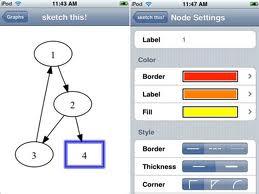
Sketch some rough shapes and lines, and Instaviz magically turns them into beautifully laid-out diagrams. Throw away the exercise books and paper napkins, Instaviz will figure it out for you. Brainstorm and conceptualize like you use pencil and paper, without a pesky interface getting in your way. Then with a couple of taps, share your diagrams with friends and colleagues through email and web.
http://instaviz.com
No.12 Idea Board:


This is a simple to use whiteboard app available for the iPad. It is a easy way for you to record your ideas anywhere. It provides a clean end product with excellent sketch facilities especially when you use the graph paper. Good to use for recording students brainstorms or discussions.
http://itunes.apple.com/us/app/idea-boards/id364902352?mt=8
No.13 Easy Chart HD:


In Easy Chart HD you can create line, bar, pie and sidebar charts easily. This application provides you simple and beautiful charts on your iPad. You can save in photos in different sizes like small, medium and large. You can also able to use this application without an internet connection. With a connection you can link your chart to social networking sites like Facebook and Twitter. Simple beautiful charts.
http://itunes.apple.com/us/app/easy-chart/id359795075?mt=8
No.14 Corkulous:


This is a great little app for creating idea boards. It has the ability to use labels or notes to record ideas as they happen. It incorporates to do lists and can import contacts from your address book. It also allows the user to paste up photos on an ever-increasing board to records your whole thought process. The app also allow for pinch zooming in order to go back and check the details of all those ideas.
http://www.appigo.com/corkulous
No.15 SadinsWiteboard:


Transform your iPad into a presentation screen with Whiteboard. Whiteboard lets you connect to a TV or projection system using an Apple VGA or composite/component video-out cable and draw directly to an external screen using standard whiteboard markers and erasers.
http://itunes.apple.com/au/app/saduns-whiteboard/id372650202?mt=8


Sunday, March 15, 2015

Anatomy of the Diaphragm

Diaphragm is composed of voluntary muscles and reaches up to the lower-most part of rib cage. Diaphragm is the structure that separates the abdominal and thoracic cavities that is composed of the heart, ribs, and lungs and is particularly accountable for the respiratory operations.

The diaphragm can be partioned into 3 segments: the sternal, costal, and lumbar components. The sternal part of diaphragm consists of the 2 muscular slips from xiphoid process. Conversely, the costal part combines with the transverse muscle of abdomen. It comprises of the cartilages and nearby parts of the 6 ribs situated around the thoracic cavity. Finally, the lumbar section of the diaphragm consists of lumbocostal arches as well as the crura. The diaphragm has many openings within it to permit the passage of other structures between the abdomen and the thorax. In addition to the minor ones, there are 3 primary openings in the diaphragm. The names of the openings are the esophageal, aortic and infeiror vena caval, allowing corresponding structures through them.

Diaphragm is an important part of the human body because of the fact that it performs on various tasks which are vital to keep someone living. During respiration, the diaphragm contracts to expand the thoracic cavity, while allows lung to enlarge and store more air. This phenomenon occurs in 2 diverse styles of respiration. The first is known as abdominal respiration, where the thoracic cavity stretches downwards. The 2nd kind of respiration is known as thoracic respiration and enables the thoracic cavity to extend upwards.

Diaphragm is also related to various other tasks not related to breathing. For instance, it participates in actions such as vomiting and parturition. The diaphragm is involved in all these actions by raising the intra-abdominal stress of the human body. In vomiting, the diaphragm may also help to prevent vomiting. This is done by the diaphragm exerting stress around the esophagus as it passes through the esophageal opening.

Probably the most usual affiliated actions of the diaphragm is hiccups. These are involuntary and sharp contractions of the diaphragm. Cause of hiccups is the acute rush of air towards the lungs pushing the vocal cords to shut. Despite the fact that we all believe that hiccups are often bothersome or distressing, it must be considered that theyre safe to the human body. Hiccups do generally vanish rather rapidly after first appearing. Therefore it is only a matter of waiting for the diaphragm to become normal.

Please visit: Functions of Diaphragm for more content on the topic.

Tuesday, March 10, 2015

10 Notable Kingdoms Established During the Pre colonial Philippines

Not known to many Filipinos, several kingdoms have been established somewhere else in the archipelago before the Spaniards conquered the Philippines.

Cultural achievements of pre-colonial PhilippinesImage via Wikipedia


Image Source

1.) Kingdom of Namayan


Image Source

Ming dynasty porcelain

The Kingdom of Namayan is an ancient kingdom that dominated the area around the upper portion of the Pasig River and the coast of Laguna Lake. It is older than the Kingdom of Tondo and Kingdom of Maynila.  This kingdom, which was formed by a confederation of barangays, reached its peak in 1175 CE. It is also alternately referred to as the Kingdom of Sapa, Maysapan or Nasapan after its capital which goes by those names.

2.) Kingdom of Maynila


Image Source

A portrayal of the Tagalog Maginoo class. From the Boxer Codex, c.1595 CE.

The Kingdom of Maynila, or more popularly known as Kingdom of Seludong or Saludung, is one of the 3 kingdoms that dominated the area now known as Metro Manila before the coming of the Spanish conquerors in the 16th century. After the Spanish colonization, it became Manila, capital of the Philippines. This kingdom was established south of the Pasig River area.

3.) Kingdom of Tondo


Image Source

Laguna Copperplate Inscription (circa 900 CE)

The Kingdom of Tondo is one of the 3 kingdoms which were established in the Pasig River area before the arrival of the Spaniards. It is also referred to as Tundo, Tundun or Tundok. This fortified kingdom, whose capital was located in the Manila Bay area, north of the Pasig River area, was known to have diplomatic ties with China during the Ming Dynasty. It traded with Brunei and allied itself to Sultan Bolkiah of Brunei.

4.) Kingdom of Butuan


Image Source

A golden vestment worn by the Hindu Brahmin Caste, found in Butuan Archeological Digs.

Another kingdom established before the coming of the Spaniards is the Kingdom of Butuan in Mindanao. This ancient Indianized kingdom centered on the present island city of Butuan was known for its mining of gold. The kingdom’s gold products were traded to Cambodia, China, India, Indonesia, Persia and Thailand.

5.) Country of Mai


Image Source

Chinese porcelain-ware, Kangxi era (1662-1722), Qing Dynasty. Ancient Chinese porcelain excavated in Mindoro, Philippines; proves the existence of trade between the island and Imperial China.

The Country of Mai was a pre-Hispanic Philippine island state founded around 1225 in Mindoro. This kingdom traded with the kingdom of Ryukyu to the Yamato Empire. It had established a trade relationship with China and as evidence, a book entitled Chu Fan Chih, described that Fukien province traded with Countr4y Mai.

6.) Sultanate of Sulu


Image Source

The official greater coat of arms of the Royal Sultanate of Sulu

The Sultanate of Sulu Dar al Islam is one of the most popular pre-Hispanic kingdoms established in the Philippines. This sultanate was an Islamic Tausug state that governed several islands of the Sulu Sea in Mindanao. This sultanate was founded in 1457 by Sayyid Abu Bakr Abirin, an Arab explorer and religious scholar.

7.) Sultanate of Maguindanao


Image Source

Flag of Maguindanao Sultanate

Another well-known sultanate established in Mindanao prior to the arrival of the Spaniards is the Sultanate of Maguindanao. This Bangsamoro state that ruled parts of the island of Mindanao in the southern part of the country had established a vast kingdom that stretched from the Zamboanga peninsula to the bay of Saranggani. During its peak, the sultanate covered the entire island of Mindanao including nearby islands.

8.) Lanao Confederation


Image Source

Sarimanok is a legendary bird of the Maranao that has become a ubiquitous symbol of their art

The Sultanates of Lanao is a kingdom established in the 16th century in Mindanao. The founding of this sultanate was through the influence of Shariff Kabungsuan. This sultanate is uniquely decentralized compared to the sultanates of Sulu and Maguindanao

9.) Confederation of Madya-as
The pre-Hispanic Philippine state known as the Confederation of Madya-as within the Visayas island region was established in the 13th century by rebel datus or chiefs led by Datu Puti, who had fled from Rajah Makatunao of Borneo. Datu Puti established a semi-democratic confederation and reached its peak during the 15th century under the leadership Datu Padojinog. The kingdom warred against the Chinese Empire, the Sultanates of Maguindanao and Sulu, the Rajahnate of Butuan and was feared by the people of the Kingdom of Tondo and Maynila. The confederation was toppled down by the Spaniards in 1569.

10.) Rajahnate of Cebu
Cebu City is regarded as the oldest Philippine city. Prior to the coming of the Spaniards, a classical state is already in existence - the Rajahnate of Cebu. The kingdom was established by Sri Lumay who was also known as Rajamuda Lumaya. He is a minor prince of the Chola dynasty that also occupied Sumatra during those days. This rajahnate allied with Butuan Rajahnate and warred with the Sultanate of Sulu.

There were several kingdoms established befored the arrival of the Spaniards. The above list were amongst the most notable once.

See also
  • 10 Dynasties That Reigned the Longest inHistory
  • Dynasties That Reigned the Longest inHistory Two
  • Dynasties That Reigned the Longest inHistory Three
Enhanced by Zemanta

Monday, March 9, 2015

Anakim Giants Skull from the Ohio Valley

Biblical Anak Giants Skulls from the Ohio Valley


This unique skull type is only found in several places in the world. It is most noted for the flattened back of the head.  This type of skull has been found in the Biblical Lands, England and the Ohio Valley.  Each of these locations were known for their conical burial mounds surrounded by a ditch that also contained the remains of a tall race of men.  In the Bible they were known as the Nephilim and the Anakim. 


Who Were the Anak?
  • Deuteronomy
    •   Whither shall we go up? our brethren have discouraged our heart, saying, The people is greater and taller than we; the cities are great and walled up to heaven; and moreover we have seen the sons of the Anakims there.
    • The Emims dwelt therein in times past, a people great, and many, and tall, as the Anakims;
    •  Which also were accounted giants, as the Anakims; but the Moabites call them Emims.
    •   A people great, and many, and tall, as the Anakims; but the LORD destroyed them before them; and they succeeded them, and dwelt in their stead:
    •  A people great and tall, the children of the Anakims, whom thou knowest, and of whom thou hast heard say, Who can stand before the children of Anak!
  • Joshua
    • And at that time came Joshua, and cut off the Anakims from the mountains, from Hebron, from Debir, from Anab, and from all the mountains of Judah, and from all the mountains of Israel: Joshua destroyed them utterly with their cities.
    •  There was none of the Anakims left in the land of the children of Israel: only in Gaza, in Gath, and in Ashdod, there remained.
    •  Now therefore give me this mountain, whereof the LORD spake in that day; for thou heardest in that day how the Anakims were there, and that the cities were great and fenced: if so be the LORD will be with me, then I shall be able to drive them out, as the LORD said.
    • And the name of Hebron before was Kirjath-arba; which Arba was a great man among the Anakims. And the land had rest from war.

The Most Famous Philippine Showbiz Personalities Socyberty

The Most Famous Philippine Showbiz Personalities | Socyberty

Here are the Philippines’ most popular showbiz celebrities of Ilocano ancestry.

 The Ilocanos are among the largest ethnic groups in the Philippines. You can almost always find an Ilocano in the four corners of the globe. Numerous Ilocanos excel in the different industries and sectors of the society.

1.) Gloria Romero


Probably the most popular actress of Ilocano descent is Gloria Romero. She was popularly known during her early days as “Manang Biday” Her father is an Ilocano from Pangasinan. She’s very old but she is still active in showbiz.

Read more...

HMH Fuse and the future of K 12 mobile education on the iPad


Last September we wrote about a fascinating project that, if successful, may ring in the future of digital curricula for K-12 education. Houghton Mifflin Harcourt, a major publisher of textbooks with an abiding interest in technology, embarked upon a large scale pilot project in digitaleducation.
As soon as their new Holt McDougal Algebra 1 textbook was finished, it was decided to re-imagine it as an iPad app named HMH Fuse Algebra 1. The app would include exactly the same content as the 950-page book, but it would also contain over 400 videos, animations, a graphing calculator, multiple presentation methods and numerous other features. John Sipe, the general sales manager of HMH, blueprinted what he wanted the app to be and worked with developers to bring it to fruition.
The free app, which weighs in at 141 MB, only gives you a taste of how it all works, but it doesnt include any course content. Seeing that requires a US$59.95 in-app purchase. Loading all the content takes up a whopping 4-6 GB of space, but chapters and videos can be downloaded, erased and reloaded at any time.
HMH took this quite seriously and poured some major money into a full-year pilot project; four California school districts were chosen, and teachers were asked to volunteer to teach a number of classes using the textbook and other classes using the app for the entire school year. HMH wanted to measure if students tested better using the app over the textbook and explore attitudinal changes in both teachers and students. All classrooms using the app needed to be Wi-Fi enabled. There was no intention of replacing teachers or turning them into mere facilitators in the HMH Fuse classes. Sipe and HMH wanted to see if delivery methods affected learning, and if so, how?

The Pilot Project

HMH bought and donated 400 64 GB Wi-Fi+3G iPads to schools in the Long Beach, Riverside, Fresno and San Francisco unified school districts. Eighth grade students in the test classes were loaned the iPads. Another 600 students took classes using only the textbooks. The same teachers taught both the test and control classes.
There was no possibility of front-loading classes with the better students getting the iPads since HMH had no control over which classes would be using the textbook or the app. The makeup of classes were determined as they always had been -- through standard class rosters provided by the school districts. The teachers who volunteered to take part knew that this would be more work than usual, and the technical capabilities of these teachers varied widely -- most of them had never touched an iPad. One day of iPad training was provided by HMH; some teachers had as little as three hours of instruction, and then HMH went away. The only contact HMH had with the schools and teachers was to provide technical assistance. Assistance was also available from representatives in the Apple educational division.
Empirical Education, a large testing company, was employed to conduct the study; it started in September of last year and will finish at the end of the school year this June when data will be compiled and presented to HMH. The major intentions were to see how the impact of multimedia and multiple presentation methods affected student perception, achievement and usage trends.
Outside of test scores, Empirical collected information on topics such as how many times students watched a video or took a quiz. Teachers were asked to periodically complete qualitative surveys on their reactions to the app, with questions ranging from how using the app affected their teaching to their impressions of student reactions. The main thrust, however, was on the students who comprise the target market.
The study began with all 1000 students using the textbook for one month since the HMH Fuse Algebra app wasnt completed until early October. All the content, including multimedia components, was available to the textbook classes on a site provided by HMH, and textbook class teachers were allowed to use all of these assets by projecting them to their classes as often as they liked. Just as students get to take home their textbooks for homework, the iPads were taken home every night by members of the HMH Fuse classes. It was left up to the teacher whether to lock down the iPads and only allow use of HMH Fuse, or to open them up to be general-purpose devices.
After tracking site usage and finding that students werent visiting anywhere inappropriate, most teachers left the iPads open, and students were encouraged to download apps and music for their personal use. This was often decided after discussions took place with teachers, parents and students. A component of the study was a students sense of ownership of the iPad.
Each iPad contained a unique identifier that was mapped to an individual student. When a test or quiz was taken, the results were immediately transferred to a teacher reporting site that provided not only the grades for a quiz or test, but also how the students fared on each relevant skill set in the assessment. In addition to assisting the teachers, this data was also harvested for the pilot study.

How One Teacher Conducted Her Classes

I interviewed Jeannetta Mitchell, a math teacher at the Presidio Middle School in San Francisco, who is currently teaching three textbook classes and one HMH Fuse class. She seemed quite impressed with the app and the effect it had on her students.
She was always interested in technology, but she didnt own an iPad or know much about them. Since a number of her students were quite familiar with varying technologies, the students and teacher learned together. "They all became teachers on how to use it." If there was a problem she could contact HMH or Apple, who were both quite responsive. HMH provided technical support but didnt assist regarding the course content since doing so would muddy the findings. Although everyone in class had their own iPad, she decided to put students in groups of two. If one person couldnt figure something out, the other usually could. It seemed to work very well.
It was important to the study that the pacing of the course be the same for all classes, so each class session, whether textbook or iPad, concentrated on the same course content. No one was allowed to get ahead. The "neat" factor and novelty of using iPads quickly wore off. By the second grading period it was gone. Surprisingly, there was no backlash from students in the textbook classes over not getting iPads. The videos embedded in the app were shown twice a week to the textbook classes using the HMH support site. Videos in her iPad class were only projected once a week, but students had instant access to watching them as many times as they liked while the textbook students could review them from home using the support site. Everyone in her textbook classes had computers at home, but no computers were used in school during class time.

Teacher Reactions to the HMH Fuse Class

Mitchell really liked having a graphing calculator built into the app that was always available. It was an advantage that "students dont have to buy a graphing calculator." Although one was available from the support site for textbook class homework, that was far less convenient and precluded students that hadnt bought a calculator from following along to immediately see how changing a variable would affect the slope of a curve.
Often in her classes she would have students try out a problem, and then shed ask for a show of hands of how many got it right or wrong. Eighth-grade students dont like to be singled out, so the number of hands that went up never matched reality. The HMH Fuse app contains a built-in polling function that she called a "teacher clicker." In the iPad class, when asked about their success on a problem, students could anonymously tap a button which recorded instant results that she could see and have projected. The anonymity of this system caused the students to answer honestly. Using the immediate information provided, it was made apparent what was well learned and what had to be re-taught. This was a great time saver.
HMH Fuse uses multiple presentation methods. When a video plays, the text being spoken appears below it. Under that is a window that shows bullet points of the main concepts. To the right is a larger section titled "Lesson Tutorials" where the problem under discussion is visually worked out step-by-step. Below that is another display that defines the meaning of words used in the example.

Since its been widely proven that some people learn better through sound, some through visuals and others through reading, this multiple methods approach was quite helpful in having students understand concepts quicker than just using going through the problem on the board at the front of the class. To support this, there is a "Notes" function, available anywhere in the app, where a student can record the teachers voice, write some information, and save a marker to the note in just the right place for later retrieval. This proved to be a great help and made the app more personal for each student.
"View in Motion," which displays a step-by-step method of problem solving, was also quite useful.

This option starts with a problem, and a downward swipe on the right goes through the solution one step at a time. Swiping upward takes you back a step. This programmed approach was a major advantage of HMH Fuse. Being able to pause a problem in progress was quite effective, as was the ability to try out a problem and get the answer on the same screen without needing to flip to the back of the book to find the answer. According to Mitchell, HMH Fuse is "much more student- and teacher-friendly" than using the textbook.

Student Reactions

Mitchell found that the students in the iPad class were more motivated than those in the other classes. She thought that this might have been due to the difference in student perception of being a few chapters into the book and realizing that another 800 pages need to be completed, while the iPad class only saw what was relevant and didnt know that there was another ton of content to finish.
The iPad students didnt give up as frequently and wound up being more focused on the task at hand both in class and in their homework. Not seeing how little they had accomplished near the start of the year was quite motivating to students in the test class. According to Mitchell, the iPad class students were far less intimidated by the content, and "they do better because they think they can do this." This attitudinal change wasnt apparent in the textbook classes. Students in those classes showed no change in attitude or motivation and just demonstrated a continuation of previous behavior. Mitchell found that one of the things the iPad wont do is to provide motivation by itself. "It does affect them most of the time, but its not a magic wand."

Initial Results

Although the pilot wont be finished until the end of the school year in June, and the results wont be made known to HMH until a few weeks later, some results were leaked to The Press-Enterprise, a Southern California newspaper. At the Amelia Earhart Middle School in the Riverside California district, two teachers have been using the HMH Fuse app to teach two classes. In a recent district wide test, the students in the iPad courses demonstrated a proficiency rate of 90.5 percent while the students in textbook classes scored only 60 percent. Although not conclusive, this is good news for HMH.

The Future of Mobile Curriculum Design

If this test proves successful, HMH Fuse will be become a brand for all Houghton Mifflin Harcourt mobile curricula. The second project, HMH Fuse Geometry, is already in the App Store. It contains the first chapter of content. Not including content in the Algebra app was a mistake, according to HMHs John Sipe. The road map includes an Algebra 2 app due to be released in late spring to allow institutional purchasing for the following school year.
The intention is to expand out of math and cover other subjects. Currently HMH has a partnership with The History Channel that can provide a wealth of assets for tackling a history curriculum. The apps will be sold to both school districts and parents of students who are home schooled, which is an increasing market. Of course, individual in-app purchases wont contain the communication and data collection capabilities of the apps in schools. The pricing will be set to be attractive to all concerned. For example, the Algebra 1 paper book used in the pilot project sells for $74, while the in app purchase of the book costs $59.95. School districts will get a 30 percent discount for volume buys.
The initial results are anecdotal at best, but it looks good, and since the HMH Fuse Algebra 1 app is the first complete curriculum developed for the K-12 market with everything else to date being geared toward higher education, HMH Fuse may well be the face of in-school mobile curricula. According to Sipe, the iPad is currently the perfect delivery vehicle.
The following video shows the introduction of the pilot project to students at the Amelia Earhart Middle School. Its quite long, but if you jump about nine minutes in, youll see Dr. Edward Burger, one of the authors of the textbook and app, introducing and demonstrating HMH Fuse Algebra 1.